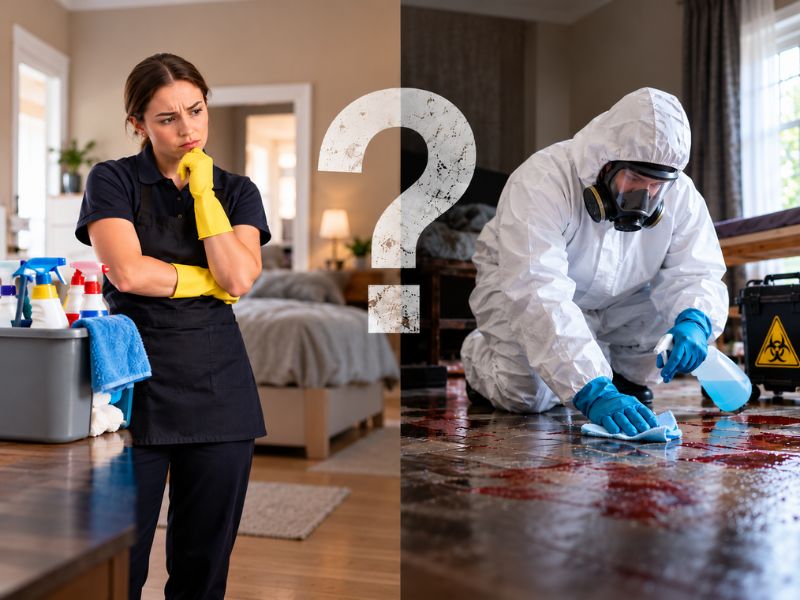
Most everyday cleaning can be safely handled by an experienced domestic or commercial cleaner. However, there comes a point where a cleaning job moves beyond dust, dirt and general hygiene and becomes a matter of Hazard Cleanup. When blood, bodily fluids, decomposition, needles, human waste or other potentially hazardous materials are present, the job may require specialist training, appropriate PPE, controlled cleaning methods and correct waste handling rather than routine cleaning alone.
Knowing where that line sits is important for landlords, letting agents, property managers, businesses, councils, social workers, housing teams, facilities managers and families. Asking an ordinary cleaner to deal with a situation outside their training can expose them to unnecessary risks and may also leave contamination behind.
Quick answer: when does a normal cleaner become the wrong person for the job?
A normal cleaner may no longer be the right person when an environment contains biological contamination, sharps or another hazard that requires specialist assessment, cleaning and decontamination.
Examples can include:
- Blood or bodily fluids
- An unattended or undiscovered death
- Decomposition
- Needles, syringes or other sharps
- Human or animal waste
- Urine or faecal contamination
- Crime or trauma scenes
- Severe hoarding involving hazardous waste
- Contaminated flooring, furniture or building materials
- Persistent odours associated with biological contamination
- Unknown substances that could present a health risk
At this point, the priority is no longer simply to make an area look clean.
The aim is to identify the hazard, understand the extent of contamination, prevent it from spreading and determine what needs to be cleaned, disinfected or safely removed.
1 When cleaning becomes hazard cleanup
The main difference between routine cleaning and specialist hazard cleanup is the type of risk being managed.
An ordinary cleaner is generally responsible for maintaining cleanliness and hygiene. A trauma cleaner may need to:
- Assess the extent of biological contamination
- Establish which areas and materials have been affected
- Select suitable PPE
- Prevent cross-contamination
- Use appropriate cleaning and disinfecting products
- Remove contaminated materials where required
- Deal appropriately with contaminated waste
- Check whether contamination has travelled beyond the visible area
This distinction matters because biological contamination is not always restricted to what can immediately be seen.
For example:
- Blood can soak through carpet and into underlay
- Bodily fluids can travel between floorboards
- Contamination can penetrate mattresses and upholstered furniture
- Liquids can affect plasterboard and timber
- Needles can be concealed beneath belongings or waste
- Odours may originate from contamination below a visible surface
Removing a visible stain does not necessarily mean the underlying hazard has been removed.
2 Blood and bodily fluids require a different approach
The presence of blood or bodily fluids is one of the clearest indications that routine cleaning may no longer be appropriate.
These situations can occur following:
- Accidents
- Injuries
- Assaults
- Medical incidents
- Traumatic events
- Deaths
An ordinary cleaner may not have been trained to determine:
- What PPE should be worn
- How the affected area should be controlled
- How to prevent contamination being transferred elsewhere
- Which cleaning and disinfecting products are appropriate
- What contact time a product requires
- Whether porous materials can be treated
- Whether flooring or furnishings need removing
- How contaminated waste should be handled
- Whether contamination has spread beyond the visible area
Specialist biohazard cleaning is therefore not simply a more thorough version of everyday cleaning.
It involves assessing and managing risks that may not be obvious when somebody first enters the property.
3 Cleaning after a death is not a routine deep clean
Cleaning following a death is one of the clearest examples of when a normal cleaner can become the wrong person for the job.
Not every death creates extensive biological contamination. However, where blood, bodily fluids or decomposition are present, specialist cleaning may be necessary.
This is particularly important following an unattended or undiscovered death.
Depending on how long a person remained undiscovered and the circumstances involved, contamination may affect:
- Carpets
- Carpet underlay
- Mattresses
- Beds
- Upholstered furniture
- Laminate or other flooring
- Floorboards
- Walls
- Skirting boards
- Nearby belongings
- Other porous materials
Professional House Cleaning After Death therefore involves more than making the room look clean again.
The affected area needs to be properly assessed so the team can establish what can be professionally treated and what may need to be safely removed.
For families, landlords and property managers, using a specialist team also means they do not have to deal personally with potentially hazardous or distressing contamination.
You can also read more about our approach to After Death Clean Up and how we approach these situations professionally and sensitively.
4 Needles and sharps should never be treated as ordinary rubbish
A discarded needle might look like another piece of waste, but it should never automatically be treated in the same way as ordinary litter.
Needles, syringes and other sharps create the potential for injury and may sometimes be contaminated.
They can also be hidden beneath:
- Rubbish
- Clothing
- Bedding
- Furniture
- Carpets
- Boxes
- Household belongings
- Vegetation
- Accumulated waste
This can be particularly relevant in:
- Vacant properties
- Social housing
- HMOs
- Communal areas
- Commercial premises
- Car parks
- Public areas
- Hoarded properties
- Abandoned buildings
Landlords, property managers, cleaners and maintenance teams should not be expected to search through potentially contaminated material where hidden sharps may be present.
Trauma Clean 24 Seven provides specialist Needle Clean Up, including searches, collection and appropriate disposal.
If there is reason to believe hidden needles may be present, the environment should be assessed before routine cleaners, maintenance staff or contractors begin work.
5 Crime and trauma scenes need specialist attention
Following an assault, serious accident or other traumatic incident, an affected area may contain blood, bodily fluids or contaminated materials.
That makes the situation more than simply a difficult cleaning job.
There can be risks associated with the contamination itself, while the emotional nature of the environment may also make the work unsuitable for staff who have no experience of trauma scenes.
Professional Crime Scene Cleaning can involve:
- Assessing the affected area
- Cleaning blood and bodily fluid contamination
- Disinfecting appropriate surfaces
- Removing contaminated materials
- Treating affected flooring or furniture
- Managing contaminated waste
- Addressing persistent odours
- Checking areas beyond the immediately visible contamination
A standard cleaner should not be placed in a position where they are expected to make decisions about managing a potentially hazardous trauma scene without the appropriate training.
6 Hoarding can move from clutter to a genuine hazard
A cluttered property does not automatically require a specialist trauma cleaning company.
However, severe hoarding can create an environment where multiple health and safety concerns exist at the same time.
These may include:
- Human waste
- Animal waste
- Rotting food
- Pest activity
- Needles or sharps
- Contaminated furniture
- Soiled mattresses
- Large volumes of refuse
- Mould
- Blocked access routes
- Unknown substances
- Trip hazards
At this point, the job may no longer simply involve removing unwanted possessions and carrying out a deep clean.
Professional Hoarding Clean Up requires a structured and sensitive approach.
Before clearance begins, technicians also need to consider whether hazards may be hidden underneath accumulated belongings.
This is especially important where nobody can confidently confirm what may be present within the property.
7 When contamination goes below the surface
One of the biggest differences between routine cleaning and specialist hazard cleanup is understanding what may be happening below the visible surface.
A stain can disappear while contamination remains underneath.
Biological fluids can potentially penetrate:
- Carpet
- Underlay
- Mattresses
- Upholstered furniture
- Laminate joints
- Timber flooring
- Floorboards
- Plasterboard
- Other porous building materials
A specialist assessment helps establish the true extent of the affected area.
In some situations, materials can be professionally cleaned and treated.
In others, removing contaminated material may be necessary because the contamination has penetrated too deeply for surface treatment alone to provide an appropriate solution.
This is why simply asking whether something “looks clean” is not enough when biological contamination is involved.
8 Persistent odours can indicate hidden contamination
Persistent odour can also be an indication that an ordinary deep clean is not addressing the real problem.
Air fresheners, fragrances and surface cleaning may temporarily disguise an odour, but they do not remove its source.
Where odour is associated with:
- Decomposition
- Blood or bodily fluids
- Human waste
- Urine
- Faecal contamination
- Contaminated furniture
- Biological material
the underlying source needs to be identified.
This could involve:
- Inspecting beneath flooring
- Checking porous materials
- Removing contaminated furniture
- Accessing concealed areas
- Treating affected building materials
- Removing materials that cannot be adequately decontaminated
Effective hazard cleanup focuses on addressing the source rather than simply masking the smell.
9 Protecting ordinary cleaners and maintenance teams
Recognising that a specialist is required does not mean an ordinary cleaner lacks ability.
It simply means the job requires a different type of training and experience.
Domestic and commercial cleaners perform an essential role in keeping properties clean and hygienic. However, this does not automatically mean they are trained to deal with:
- Blood
- Bodily fluids
- Decomposition
- Sharps
- Human waste
- Contaminated building materials
- Biohazard waste
- Unknown biological substances
The same principle applies to:
- Caretakers
- Housing officers
- Social housing teams
- Facilities staff
- Maintenance operatives
- Property managers
- Landlords
- Letting agents
- Hotel staff
- Site teams
A member of staff should not be expected to handle a substance simply because cleaning is part of their normal role.
If people are uncertain about what a substance is, whether it presents a risk or how it should be removed, that is a strong indication that specialist advice should be sought.
Common questions about hazard cleanup
Can a normal cleaner clean up blood?
It depends on the amount of contamination, the circumstances and the environment.
Some workplaces may have procedures for dealing with very minor incidents. However, significant or unknown blood contamination may require specialist assessment.
Factors to consider include:
- How much blood is present
- Which surfaces have been affected
- Whether it has penetrated porous materials
- Whether the source of the blood is known
- Whether contaminated materials require removal
- Whether there is a risk of spreading contamination elsewhere
Where there is uncertainty, professional advice should be sought before cleaning begins.
Why can’t you just use bleach?
Hazard cleanup involves considerably more than selecting a strong cleaning chemical.
Factors that need to be considered include:
- The type of contamination
- The surface being treated
- Product suitability
- Correct dilution
- Application method
- Required contact time
- PPE
- Ventilation
- Cross-contamination control
- Waste handling
Using an unsuitable chemical or using a product incorrectly can also damage surfaces or create additional risks.
What should I do if I find an unknown substance?
Do not immediately touch, smell or attempt to clean an unknown substance if there is reason to believe it could present a hazard.
Where appropriate:
- Keep people away from the immediate area
- Avoid disturbing the substance
- Do not ask an untrained cleaner to investigate it
- Seek specialist advice if biological contamination is suspected
Does contaminated carpet always need removing?
No.
Whether a carpet can be treated depends on factors such as:
- What the carpet has been contaminated with
- How much contamination is present
- How long it has been there
- Whether it has soaked through the carpet
- Whether the underlay is affected
- Whether contamination has reached the flooring beneath
A specialist assessment can determine the most appropriate course of action.
Can Trauma Clean 24 Seven attend commercial properties?
Yes. Specialist hazard cleanup is not limited to domestic homes.
Trauma Clean 24 Seven can assist in environments including:
- Commercial premises
- Hotels
- Offices
- Rental properties
- Social housing
- HMOs
- Communal areas
- Public buildings
- Vacant properties
- Managed residential properties
The approach will depend on the type, extent and location of the contamination.
When should you call Trauma Clean 24 Seven?
If a situation involves blood, bodily fluids, decomposition, needles, human waste, significant contamination or an unknown biological hazard, it may be time to stop treating the situation as a routine cleaning job.
Trauma Clean 24 Seven provides specialist services including:
- Hazard Cleanup
- House Cleaning After Death
- After Death Cleaning Services
- Needle Clean Up
- Crime Scene Cleaning
- Hoarding Clean Up
Our experienced trauma cleaning team approaches every enquiry professionally, sensitively and discreetly.
Depending on the circumstances, we can:
- Assess the affected area
- Establish the extent of contamination
- Identify materials requiring treatment
- Determine whether contaminated materials need removing
- Carry out specialist cleaning and decontamination
- Manage contaminated waste appropriately
- Provide clear information about the work undertaken
Ultimately, the question is not whether an ordinary cleaner is capable of cleaning.
It is whether the environment has moved beyond routine cleaning and into hazard cleanup, biohazard management and specialist decontamination.
Once that line has been crossed, a trained specialist is the appropriate person for the job.
For sensitive advice or to discuss a specialist clean, contact our expert Operations Team at Trauma Clean 24 Seven.