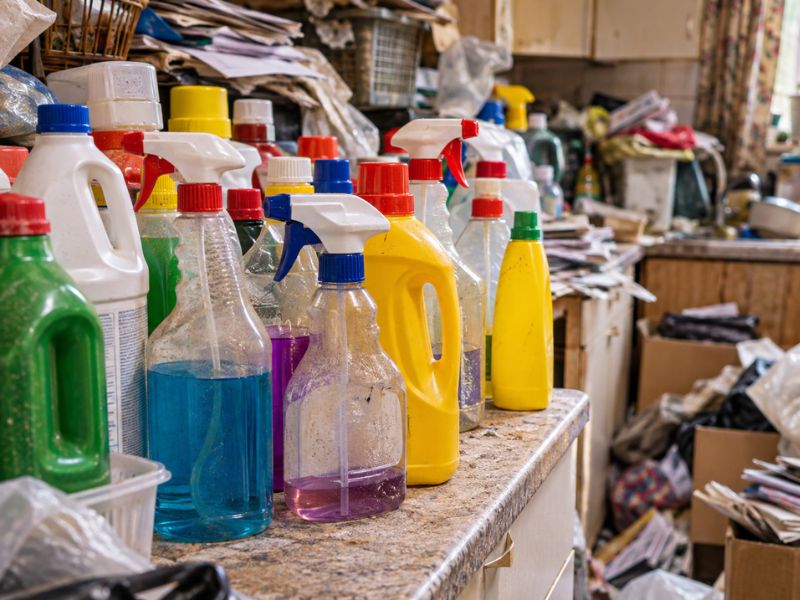
Why might a severely cluttered home contain dozens of bottles of bleach, disinfectant and household cleaning sprays, many of which have never been opened? It is something that can be encountered during a professional hoarding clean up, and at first glance, it might seem contradictory.
A property may be filled with accumulated possessions, making everyday cleaning almost impossible, yet cupboards, shelves and worktops contain large quantities of cleaning supplies.
It would be easy to assume that someone living in these conditions simply doesn’t care about cleanliness. However, the reality can be much more complicated.
For some people experiencing hoarding difficulties, buying cleaning products may represent a genuine intention to improve their living environment. For others, it may be linked to anxiety, fears about running out or difficulties discarding possessions.
Understanding these possible explanations can help families, landlords, councils and housing associations approach hoarding situations with greater sensitivity.
Why Do People Who Hoard Collect Cleaning Products?
There is no single reason why someone affected by hoarding may accumulate large quantities of household cleaning products.
Hoarding disorder is a recognised mental health condition involving persistent difficulty discarding possessions, often resulting in clutter that affects everyday living.
According to the NHS, people experiencing hoarding disorder may find it difficult to use rooms for their intended purpose or carry out everyday activities such as cooking and cleaning.
Although research specifically examining the stockpiling of cleaning products is limited, several recognised aspects of hoarding behaviour may help explain why it happens.
1. Buying Cleaning Products Can Represent an Intention to Clean
One possible explanation is that the person genuinely wants to improve their living conditions.
They may regularly purchase disinfectants, cleaning sprays, bin bags and cloths with every intention of tackling the clutter.
However, once they return home, the scale of the task can become overwhelming.
Where should they start? What should they keep? What can they throw away? How can they clean surfaces that are completely covered with possessions?
For someone who struggles with decision-making or experiences distress when discarding belongings, these questions can become significant barriers.
Buying cleaning products might feel like a positive first step, even when the cleaning itself never takes place.
Over time, repeated purchases can contribute to the existing clutter.
The presence of unused cleaning products does not necessarily mean someone has given up on maintaining their home.
2. Purchasing Supplies May Provide a Sense of Control
Hoarding difficulties can be associated with anxiety, emotional distress and problems making decisions.
When a home becomes increasingly cluttered, everyday household tasks can feel difficult to manage.
For some individuals, purchasing cleaning supplies may offer temporary reassurance that they are preparing to improve their surroundings.
They might believe that buying a particular product will help motivate them to begin cleaning.
However, the emotional and practical difficulties associated with sorting and removing possessions can remain.
This may contribute to a cycle of buying supplies without being able to use them.
It is important to remember that this is only one possible explanation, and individual experiences of hoarding vary considerably.
3. Fear of Running Out Can Lead to Stockpiling
Some people affected by hoarding experience a strong need to keep items because they believe they may be useful in the future.
Household cleaning products can fall into this category.
Someone might purchase several bottles of bleach because they are discounted or because they worry about running out.
Others may keep large quantities of products because they believe they will eventually need them.
This behaviour can extend to toiletries, food, clothing and other everyday household essentials.
The problem arises when accumulating these items begins to interfere with the person’s ability to use and maintain their home.
During a hoarding clean up, large quantities of duplicated products may need to be assessed alongside other accumulated possessions.
4. Cleaning Products Can Become Part of the Hoard
Hoarding is not always limited to newspapers, furniture, clothing or sentimental belongings.
Some individuals struggle to discard ordinary household items, including empty containers, partly used products and cleaning supplies.
They may believe that throwing away something they have purchased is wasteful or that it could be useful at some point.
This can make even seemingly insignificant items difficult to part with.
Over time, cleaning products can become part of the wider accumulation of possessions.
For those involved in cleaning out a hoarders house, understanding the potential attachment to everyday objects is important.
What appears unnecessary to one person may hold significant practical or emotional value to another.
5. People May Forget What Cleaning Products They Already Own
In heavily cluttered homes, storage cupboards, shelves and worktops can become inaccessible.
Everyday items may disappear beneath accumulated possessions.
Someone may purchase another bottle of disinfectant because they cannot locate the one they already own.
They might also forget how many products they have purchased, especially when similar items are stored in different rooms.
Over time, this can result in multiple identical products accumulating throughout the property.
It highlights how severe clutter can affect even the simplest household tasks.
6. Shame and Embarrassment May Play a Part
Some people experiencing hoarding difficulties are very aware of the condition of their home.
They may feel embarrassed about inviting friends or relatives inside or worry about inspections by landlords, housing officers and maintenance contractors.
There may be a genuine desire to improve the property before anyone else sees it.
Purchasing cleaning products could be part of that intention.
However, the challenges associated with hoarding may make it difficult to put those plans into action.
This is why a sensitive, non-judgemental approach is so important when discussing hoarding clean up with an affected individual.
Why Having Cleaning Products Doesn’t Always Mean a Home Can Be Cleaned
There is a significant difference between owning cleaning supplies and being able to carry out the cleaning itself.
In a severely cluttered property, even straightforward household tasks can become extremely difficult.
Kitchen worktops may be inaccessible, bathrooms may be difficult to use and flooring may be covered by accumulated belongings.
Before any meaningful cleaning can begin, possessions may need to be carefully sorted, moved or removed.
For someone who experiences significant distress when discarding items, this process can be particularly challenging.
It is also important to recognise that not every severely cluttered property is the result of hoarding disorder.
Physical disabilities, illness, bereavement, mental health difficulties and reduced mobility can all affect someone’s ability to maintain their home.
The condition of a property should never be used to make assumptions about someone’s intentions, personal hygiene or mental health.
Can Large Quantities of Cleaning Products Create Safety Risks?
During a professional hoarding clean up, accumulated cleaning chemicals may present additional practical concerns.
While many household cleaning products are safe when stored and used correctly, large quantities stored in unsuitable conditions can introduce potential hazards.
These may include:
- Leaking containers: Damaged bottles may release chemicals onto surrounding possessions or surfaces.
- Chemical reactions: Mixing incompatible cleaning products, particularly bleach with acidic or ammonia-based substances, can release dangerous gases.
- Unsafe storage: Products may be stored near food, heat sources or areas accessible to children and pets.
- Restricted access: Large quantities of containers can contribute to blocked walkways and inaccessible storage areas.
- Waste disposal: Unidentified, leaking or unwanted chemicals may require appropriate handling and disposal.
Cleaning chemicals should never be mixed together or emptied indiscriminately into drains during a property clearance.
Where significant quantities of cleaning products have accumulated, the potential risks should be assessed before removal begins.
This is one reason why professional hoarding clean up services may be required when a property contains extensive clutter alongside possible safety hazards.
What Should Councils, Landlords and Housing Associations Understand About Hoarding?
For housing officers, council housing teams, property managers and landlords, finding numerous unused cleaning products in a severely cluttered home may initially seem unusual.
However, it is important to look beyond the physical condition of the property.
The accumulation of cleaning products could indicate that someone has repeatedly intended to improve their living conditions but has struggled to make progress.
Rather than assuming the person is unwilling to clean, housing providers should consider whether additional support might be appropriate.
Important questions include:
- Is the tenant struggling to manage the property independently?
- Are they finding it difficult to make decisions about their possessions?
- Are there potential risks affecting their health, safety or access to essential facilities?
- Could social care or mental health support be beneficial?
- Is professional hoarding clean up required to address immediate property concerns?
Why Property Clearance Alone May Not Resolve Hoarding Difficulties
A professional hoarding clean up can help restore access, improve hygiene and address practical hazards within a property.
However, removing accumulated belongings does not necessarily resolve the underlying difficulties associated with hoarding disorder.
Without appropriate ongoing support, possessions may begin to accumulate again.
For councils and housing associations, a coordinated approach involving housing teams, relevant support services and specialist cleaning contractors may therefore be beneficial.
The aim should be to improve the property’s condition while respecting the individual’s circumstances, dignity and wellbeing.
Read more about our specialist approach to Hoarding Clean Up.
When Is Professional Hoarding Clean Up Necessary?
Not every cluttered property requires a specialist cleaning contractor.
However, professional hoarding clean up may be needed when accumulated possessions begin to create significant hygiene, access or safety concerns.
Some properties may contain contaminated materials, spoiled food, human or animal waste, needles or other substances that require specialist handling.
In these situations, conventional domestic cleaning may not be appropriate.
At Trauma Clean 24 Seven, we understand that hoarding clean up involves much more than simply removing unwanted belongings.
Our specialist cleaning teams approach each property with sensitivity, discretion and respect for the individuals involved.
Depending on the property’s condition and the agreed scope of work, our services can include:
- Assessing the property and identifying potential hazards
- Planning the clearance and cleaning requirements
- Removing accumulated waste and unwanted materials
- Undertaking appropriate specialist cleaning and sanitisation
- Addressing areas affected by contamination
- Providing information about the work completed and any outstanding concerns
We work with private individuals, families, landlords, councils and housing associations to help manage challenging property conditions.
Every situation is different, which is why professional hoarding clean up should be planned around the condition of the property, the potential hazards and the needs of those involved.
Where hoarding disorder is present, specialist cleaning may form one part of a wider support plan.
Common Questions About Hoarding and Cleaning Products
Why do people who hoard buy cleaning products but never use them?
Some people may purchase cleaning products with the genuine intention of improving their home but become overwhelmed by the amount of clutter or the decisions involved in clearing it. Others may accumulate supplies because they worry about running out or struggle to discard possessions. There is no single explanation.
Is collecting cleaning products a sign of hoarding disorder?
Not necessarily. Buying cleaning products in bulk or keeping spare supplies is common. Hoarding disorder involves persistent difficulty discarding possessions and excessive accumulation that interferes with everyday living. Collecting cleaning products alone does not indicate a diagnosis.
Do people with hoarding disorder care about cleanliness?
Many people affected by hoarding disorder want a clean and organised home. However, the emotional and practical difficulties associated with clutter and discarding possessions may prevent them from maintaining their living environment.
Why is cleaning a hoarded property so difficult?
Severe clutter can prevent access to floors, worktops, bathrooms and other areas requiring cleaning. Sorting and removing possessions may also cause significant distress, making the process difficult without appropriate support.
What happens to cleaning chemicals during a hoarding clean up?
Cleaning products should be assessed according to their condition and potential risks. Damaged, leaking or unidentified chemicals may require specialist handling or appropriate disposal. Products should not be mixed together or discarded without considering safety requirements.
Can professional hoarding clean up prevent hoarding from happening again?
Professional hoarding clean up can address the physical condition of a property, but it does not treat hoarding disorder. Where an individual experiences ongoing difficulties, additional mental health or practical support may be needed to help prevent the accumulation of possessions from recurring.
Looking Beyond the Clutter
Finding dozens of cleaning products in a severely cluttered property may seem contradictory.
But sometimes, those bottles of disinfectant and cleaning sprays may tell a different story.
They could represent repeated intentions to clean, concerns about running out or difficulties parting with everyday possessions.
While it is impossible to determine someone’s reasons simply by looking at their belongings, the presence of cleaning products is a reminder that hoarding is often far more complex than it appears.
For councils, landlords, housing associations and families, understanding the person behind the clutter can be just as important as addressing the physical condition of the property.
A successful hoarding clean up should consider both the practical cleaning requirements and the circumstances of those affected.
Professional Hoarding Clean Up from Trauma Clean 24 Seven
Trauma Clean 24 Seven provides professional, discreet and compassionate hoarding clean up services for residential and managed properties.
We support councils, housing associations, landlords, families and private individuals who need assistance with challenging property conditions.
Our experienced specialist cleaning teams understand the importance of approaching every situation sensitively while addressing the practical cleaning, clearance and potential contamination concerns within the property.
Whether you are responsible for a severely cluttered council property, managing a tenancy or arranging assistance for a family member, our team can discuss the circumstances and advise on appropriate next steps.
Contact Trauma Clean 24 Seven to discuss your hoarding clean up requirements and request a free quotation.
Telephone: 0203 640 8247
Email: info@24sevengroup.co.uk
Website: www.traumaclean24seven.co.uk
Find out more about our Hoarding Clean Up Services.