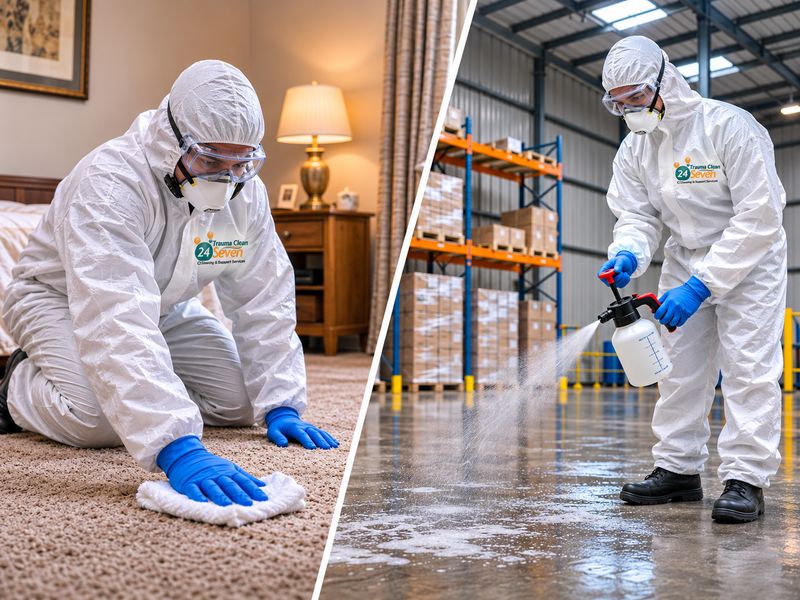
No two deaths happen under exactly the same circumstances, and no two properties are left in the same condition afterwards. This is why every Death Clean Up presents different challenges, risks and specialist cleaning requirements.
One property may require the careful cleaning and disinfection of a small, contained area. Another could involve extensive biological contamination, decomposition odours, damaged flooring or the removal of contaminated furniture and personal belongings.
At Trauma Clean 24 Seven, we understand that effective death clean up starts with assessing the circumstances, identifying the extent of contamination and developing a cleaning plan tailored to the property.
There is no single cleaning approach that works for every situation. However, the objective remains the same – to safely remove contamination, thoroughly treat affected areas and provide clear guidance to those responsible for the property.
What Determines the Type of Death Clean Up Required?
The cleaning requirements following a death depend on several factors, including how the person died, how long the property remained unattended, the surfaces affected and the overall condition of the building.
An experienced trauma cleaning team must consider each of these factors before deciding which cleaning methods, equipment and decontamination procedures are appropriate.
Here are six reasons why every death clean up is different.
1. The Circumstances of the Death
A death from natural causes may leave very different cleaning requirements from an accident, suicide or an undiscovered death.
In some circumstances, there may be little or no biological contamination, meaning specialist cleaning is unnecessary. In others, blood, bodily fluids or decomposition can create potentially hazardous conditions requiring professional intervention.
The circumstances also influence how quickly cleaning can begin.
Where police or other authorities are involved, the scene must be formally released before specialist cleaning takes place.
For our technicians, understanding the circumstances helps establish the likely contamination risks and identify where more detailed inspection may be necessary.
2. How Long the Person Remained Undiscovered
One of the biggest variables in death clean up is the length of time between a person passing away and being discovered.
When someone dies and remains undiscovered for an extended period, natural decomposition can significantly affect the surrounding environment.
Depending on the conditions, this may result in:
-
Bodily fluids penetrating mattresses, carpets, flooring and furnishings.
-
Persistent decomposition odours spreading beyond the immediate area.
-
Insect activity, including flies, larvae and maggots.
-
Contamination reaching floorboards, subfloors or structural materials.
-
The need to remove and dispose of items that cannot be effectively decontaminated.
Temperature, ventilation and humidity can also influence the rate of decomposition and the extent of the resulting contamination.
A property where someone has remained undiscovered for several weeks may therefore require substantially more extensive intervention than one where the person was found shortly after death.
Our Unattended Death Cleanup services address these more complex situations through detailed assessments, contamination removal and specialist decontamination.
3. The Type of Flooring and Surfaces Affected
Two incidents involving similar levels of biological contamination can require entirely different cleaning methods depending on the materials within the property.
For example, blood or bodily fluids on an intact, non-porous surface may be easier to contain and remove than contamination that has penetrated carpet, timber or upholstered furniture.
Porous materials can absorb biological fluids, allowing contamination to travel beneath the visible surface.
In some cases, this means lifting carpets, removing underlay or inspecting the flooring beneath.
Where contamination has penetrated deeply into materials, cleaning the visible surface alone may not be sufficient.
A room can look clean while contamination remains beneath the flooring or inside surrounding materials.
This is why a professional death clean up should focus on the full extent of contamination rather than simply improving the room’s appearance.
Our technicians assess the affected materials and determine whether they can be cleaned and decontaminated effectively or require removal.
4. The Condition of the Property Before the Death
Not every property is clean, tidy or easily accessible before a death occurs.
Some of the properties we attend have additional challenges, including accumulated belongings, poor sanitation, pest activity, structural deterioration or hoarding conditions.
In these environments, specialist death clean up can become a much larger operation.
For example, a heavily cluttered property may prevent technicians from accessing contaminated flooring or identifying affected areas.
Items may need to be carefully moved, inspected or removed before decontamination can begin.
Where hoarding is involved, the work also requires a sensitive approach to personal possessions, particularly when family members want to retain sentimental items.
Trauma Clean 24 Seven provides Hoarding Clean Up Services alongside specialist trauma cleaning, allowing us to assess wider property conditions where necessary.
However, the presence of clutter does not automatically mean an entire property needs clearing. The scope of work should reflect the actual conditions, the customer’s requirements and the risks identified during assessment.
5. Odours Do Not Always Stay in One Room
Decomposition odours can present another challenge during death clean up.
The strength and spread of an odour depend on several factors, including the stage of decomposition, room temperature, ventilation and whether contamination has penetrated absorbent materials.
In some properties, the odour remains concentrated within one room.
In others, it may spread through hallways, neighbouring rooms or shared areas within a building.
This is particularly concerning for landlords, housing associations and local authorities managing flats or multi-occupancy properties.
An unpleasant odour may also remain after visible contamination has been removed if the underlying source has not been fully addressed.
Effective odour treatment therefore starts with identifying and removing the contamination responsible.
Specialist deodorisation methods may then be appropriate, depending on the condition of the property.
Simply masking a decomposition odour with fragrance or air fresheners does not resolve the underlying problem.
6. Every Customer Has Different Requirements
The physical condition of a property is only part of the job.
The people arranging the cleaning can also have very different needs.
A family member arranging cleaning after losing a loved one may need time to identify possessions they wish to keep.
A landlord may need the property assessed, cleaned and prepared for necessary repairs.
A housing association or local authority may require a detailed record of the work completed, including areas treated, contaminated waste removed and any outstanding maintenance concerns.
A solicitor or estate representative may need information about the property’s condition before arranging a wider clearance.
At Trauma Clean 24 Seven, we understand that communication is an important part of specialist cleaning.
We explain the proposed work, identify any limitations and keep customers informed where additional cleaning or remedial work becomes necessary.
Every situation requires sensitivity, discretion and an approach that reflects the circumstances.
Why a Death Clean Up Assessment Matters
Because every incident is different, it is important to establish the extent of the work before beginning.
A professional assessment helps determine which areas require treatment, what materials may need removing and whether further investigation is necessary.
At Trauma Clean 24 Seven, our approach generally involves:
1 Initial assessment
We review the available information about the incident and assess the property to identify visible contamination, potential hidden risks and access requirements.
2 Developing a cleaning plan
Our team selects appropriate cleaning and decontamination methods, personal protective equipment and waste-handling procedures.
3 Removing contaminated materials
Where materials cannot be safely or effectively decontaminated, we arrange their removal and appropriate disposal, subject to the agreed scope of work.
4 Specialist cleaning and disinfection
We clean affected surfaces, remove biological contamination and apply suitable disinfection procedures based on the materials and risks involved.
5 Addressing residual odours
Where necessary, we identify remaining odour sources and carry out appropriate treatment once the underlying contamination has been addressed.
6 Reviewing and documenting the work
We review the areas treated and identify any limitations or further repairs that may be required. Where requested, we can provide supporting documentation for property management and maintenance records.
For more information about the specialist treatment of biological contamination, visit our Bio Hazard Clean Up service page.
Why the Cheapest Death Clean Up Quote May Not Cover the Same Work
When obtaining quotes for death clean up, it is important to understand exactly what the proposed service includes.
Two contractors may quote different prices because they have assessed different levels of contamination or allowed for different work.
One quotation may cover visible surface cleaning, while another may include lifting flooring, removing contaminated materials, specialist waste disposal and odour treatment.
A lower price does not necessarily represent better value if important areas remain untreated.
Equally, not every incident requires extensive removal or property clearance.
The appropriate scope of work should be determined by the actual contamination, not by a standard cleaning package.
Before appointing a contractor, customers should understand which areas will be cleaned, whether contaminated materials will be removed, how waste will be handled and what documentation will be provided.
This is particularly important for councils, housing providers and landlords who need reliable records of the work undertaken.
Common Questions About Death Clean Up
Does every death in a property require specialist cleaning?
No. A death does not automatically mean a property has become contaminated. Specialist cleaning is generally required where blood, bodily fluids, decomposition or other potentially hazardous materials are present.
How long does a death clean up take?
The duration depends on the extent of contamination, the size and condition of the property, access restrictions and whether materials need removing. Some jobs may be completed within a day, while more complex situations require additional time or separate visits.
Can you clean a property where someone has been undiscovered for several weeks?
Yes. Trauma Clean 24 Seven provides specialist unattended death cleanup, including the assessment and treatment of affected surfaces, contaminated materials and associated odours.
Will all the furniture and belongings need to be removed?
Not necessarily. We assess items individually where appropriate. Some can be cleaned and retained, while others may be too contaminated to decontaminate effectively. We discuss the proposed removal of belongings with the responsible person before proceeding.
Can death clean up involve lifting carpets or floorboards?
Yes. Where bodily fluids have penetrated flooring, technicians may need to remove carpets, underlay or other affected materials to access contamination beneath the surface. More extensive structural work may need a separate contractor.
Can decomposition odours affect neighbouring properties?
Yes. In certain building layouts, decomposition odours may travel through gaps, shared spaces or ventilation pathways. The underlying source should be investigated and addressed rather than simply masking the smell.
Do you provide death clean up services for councils and housing associations?
Yes. Trauma Clean 24 Seven works with property owners, landlords, housing providers and local authorities requiring discreet specialist cleaning. We can also provide documentation detailing work completed and identifying areas requiring further attention.
How do I arrange professional death clean up?
Contact Trauma Clean 24 Seven with the property location and any information available about the circumstances. Our team can explain the next steps, discuss access arrangements and advise on the assessment required.
A Different Property. A Different Challenge. The Same Professional Approach.
No two death clean up jobs are the same because no two circumstances, properties or customers are identical.
Some incidents require relatively contained cleaning and disinfection. Others involve extensive contamination, difficult access, complex waste removal or additional property maintenance.
What matters is recognising those differences and carrying out the work appropriate to each individual situation.
At Trauma Clean 24 Seven, we provide discreet, compassionate and professional Death Clean Up services for families, landlords, housing associations, councils and property management teams.
We assess each situation on its own merits, explain the work required and approach every property with care and respect.
Need specialist death clean up services?
Contact Trauma Clean 24 Seven to discuss your requirements confidentially.
Telephone: 0203 640 8247
Email: info@24sevengroup.co.uk